 Posted by Luca Giordano
 On Fri Oct 2
Author: Luca Giordano, Sales Engineer, Key Accounts, Chateau Energy Solutions
I’ve had some version of the same conversation with several data center teams recently.
We are working through a medium voltage equipment package, someone asks whether the equipment is UL Listed, and when the answer is no, concern follows quickly.
I understand why. Procurement teams and engineers are used to seeing UL marks throughout a facility. When that familiar mark is missing from a major piece of electrical equipment, it can feel like something has been overlooked.
But some medium-voltage equipment used in data centers does not carry a factory UL Listing, and that does not automatically mean the equipment is unsafe, noncompliant, or unusable.
The more important questions are what standards the equipment was designed and tested to, what the project requires, whether a field evaluation will be needed, and how the Authority Having Jurisdiction (AHJ) will ultimately accept the equipment.
Those questions need to be addressed during procurement, not when the equipment is sitting at the data center and the project is preparing for energization.
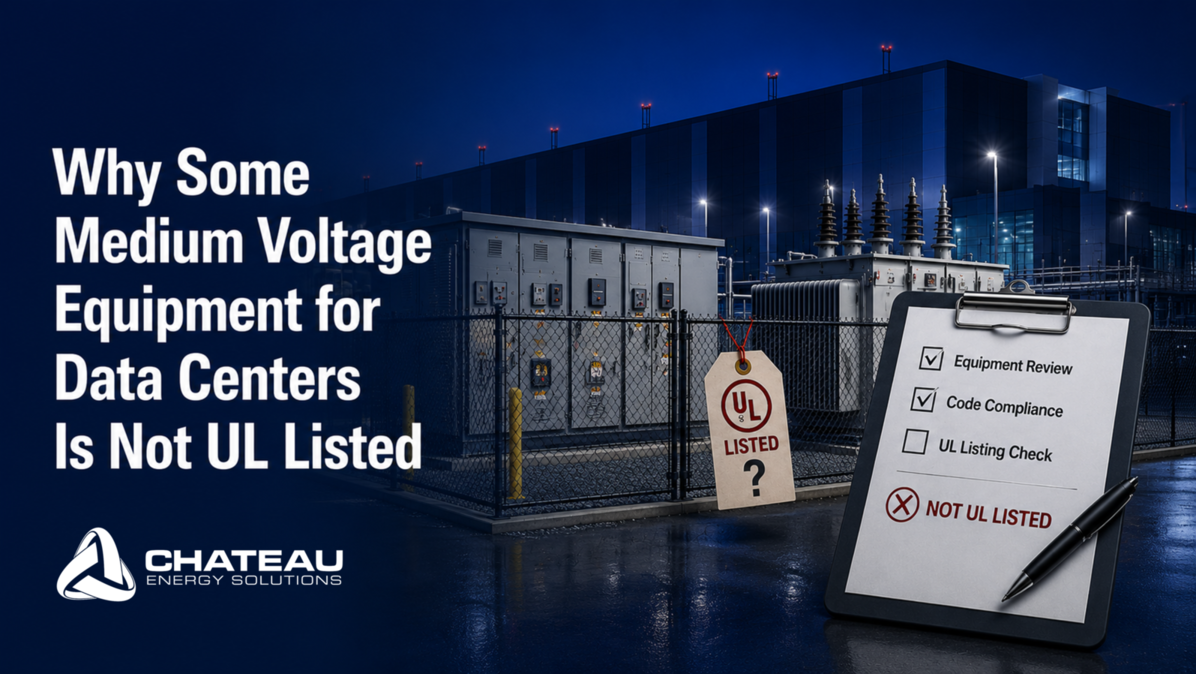
Some medium voltage equipment does not have a factory UL Listing because data center electrical systems often use engineered or project-specific equipment that may be evaluated differently from standardized electrical products. Medium voltage is not exempt from UL certification; UL Solutions provides testing and certification for many categories of medium-voltage distribution equipment.
At the same time, medium-voltage systems used in data centers can include custom-built assemblies, project-specific configurations, and equipment that has been modified or integrated as part of a larger power architecture. UL Solutions specifically identifies unlisted, custom-built, modified, and imported equipment as situations where field evaluation can become important on data center projects.
A missing factory UL Listing should not automatically end the conversation about a piece of equipment. It should start a different conversation: What standards apply to this equipment, what testing has been completed, and what is the path to acceptance at this data center?
Chateau Energy works with the data center developer or procurement team, the equipment manufacturer, and the appropriate field evaluation organization to establish and manage the medium voltage equipment acceptance process. This coordination is part of the OFCI (owner furnished contractor installed) program management we provide for medium voltage equipment.
I want the field evaluation requirement identified while we are still working with the manufacturer, not discovered after the equipment reaches the site.
If a field evaluation is required, there are additional details Chateau Energy will coordinate. We need to identify the organization that will perform the evaluation, understand which drawings and test documents they will need, and determine when to bring them into the process. It is also important to confirm whether any part of the review can happen before the equipment ships, whether testing or inspection must occur at the site, and how the manufacturer will address any deficiencies the evaluator identifies.
Chateau Energy helps manage those conversations between the data center team, manufacturer, and evaluator so the process stays aligned with the equipment schedule and the project’s energization requirements.
This is why we look at OFCI as more than equipment procurement. Securing a production slot and getting switchgear or transformers delivered are major milestones, but the equipment still has to be accepted, installed, tested, and commissioned before the data center can energize.

Medium voltage switchgear and transformers in data centers are commonly designed and tested to applicable IEEE (Institute of Electrical and Electronics Engineering) and ANSI (American National Standards Institute) standards, while UL certification or field evaluation is a separate equipment-acceptance process. The specific requirements depend on the equipment type, project specifications, owner requirements, utility requirements and Authority Having Jurisdiction (AHJ).
For example, IEEE C37.20.2 covers metal-clad medium-voltage switchgear. The standard addresses service conditions, ratings, temperature limitations, dielectric withstand requirements, and testing procedures for equipment in this category.
Transformers have their own IEEE C57 standards. These standards address electrical and mechanical requirements and testing for many types of distribution and power transformers.
The important point for a data center procurement team is that compliance with an IEEE equipment standard and having a UL Listing are not the same thing.
One tells us about the standards to which the equipment was designed or tested. The other is a third-party certification process. Both may be relevant.
UL, CSA, NRTL and AHJ describe different organizations or roles in the electrical equipment acceptance process. They should not be used interchangeably when discussing medium voltage equipment for a data center.
UL Solutions is a testing, inspection, and certification organization. It provides product certification, as well as field evaluation services.
CSA Group is another testing and certification organization that can perform evaluations and certifications.
NRTL stands for Nationally Recognized Testing Laboratory. OSHA recognizes organizations that meet its requirements to test and certify certain products. Both UL LLC and CSA Group Testing and Certification Inc. appear on OSHA’s current NRTL list, along with other recognized organizations.
The AHJ, or Authority Having Jurisdiction, has a different role. The AHJ is responsible for enforcing the applicable requirements and approving the equipment or installation within its jurisdiction.
The goal is not simply to find a UL or CSA label. The goal is to establish how the equipment will be accepted for the specific data center project.
A field evaluation may be required when medium voltage equipment does not have the certification or labeling required for the installation. The exact requirement depends on the equipment, project specifications, owner requirements, and the AHJ.
UL Solutions describes field evaluation as an on-site process that can be used for equipment that is unlisted, custom-built, modified, or otherwise lacks the certification documentation expected by code authorities. Its data center guidance specifically identifies these situations as potential sources of compliance issues and project delays.
A field evaluation can include documentation review, visual and mechanical inspection, applicable testing, and an evaluation report. If the equipment satisfies the applicable requirements, an evaluation label may be applied.
That should not be interpreted to mean that unlisted equipment will automatically pass. In fact, the absence of a required listing or certification should be treated as an unresolved acceptance issue until the equipment has been evaluated and accepted through the applicable process.
The evaluator may identify changes that have to be made before the equipment is accepted. Those changes can involve the manufacturer, the equipment integrator, the installation team, or multiple parties.
That is exactly why timing matters. A field evaluation identified during procurement can be managed. A field evaluation discovered immediately before energization can become a schedule issue.

Data center developers and procurement teams should confirm the equipment standards, certification requirements, and acceptance path before the medium voltage equipment order is placed. These items belong in the procurement process alongside equipment specifications, lead times, and delivery dates.
At a minimum, I want the team to understand:
Chateau Energy works with data center developers and procurement teams to manage the path from medium voltage equipment procurement through acceptance, delivery, testing, commissioning, and energization. Our OFCI program management includes coordinating manufacturers, documentation, and field evaluation requirements so potential issues can be addressed earlier in the project.
Talk With Our Mission Critical Team
Does medium voltage equipment for a data center have to be UL Listed?
Not necessarily in every situation. UL certifies many categories of medium voltage distribution equipment, but a particular piece of data center equipment may be custom-built, modified, or otherwise supplied without a traditional factory UL Listing.
The applicable project specifications, equipment standards, owner requirements, and AHJ requirements need to be reviewed to determine the appropriate acceptance path.
Chateau Energy helps data center teams identify those requirements as part of our medium voltage equipment procurement and OFCI program management.
Can a data center use medium voltage equipment that is not UL Listed?
Potentially, yes. The absence of a factory UL Listing does not automatically mean medium voltage equipment cannot be installed at a data center.
Depending on the project, unlisted equipment may need to go through a field evaluation or another applicable acceptance process before the installation is approved. The equipment still has to satisfy the applicable requirements, and any deficiencies identified during evaluation must be resolved.
What is a field evaluation for medium voltage equipment at a data center?
A field evaluation is an assessment of equipment that does not have the certification or labeling required for its particular installation. It can involve documentation review, equipment inspection, applicable testing, and an evaluation report or label.
Chateau Energy can coordinate this process with the data center developer or procurement team, the equipment manufacturer, and the field evaluation organization as part of our OFCI program management.
Is CSA approval required for medium voltage equipment at every data center?
No. CSA inspection or evaluation is not a universal requirement for every medium voltage installation.
CSA Group may be the selected certification or field evaluation organization on a particular project, but UL and other qualified organizations also perform this type of work. The correct path depends on the project’s requirements and AHJ expectations.
What is the difference between UL certification and IEEE compliance for medium voltage equipment?
IEEE standards establish technical requirements for the design, ratings, performance, and testing of many types of medium voltage equipment. UL certification is a separate third-party conformity assessment process.
A data center equipment package may therefore need to address both applicable IEEE standards and certification or field evaluation requirements.
When should a data center team determine whether a field evaluation will be required?
The field evaluation requirement should be determined during equipment procurement, preferably before manufacturing and delivery are far along.
Identifying it early gives the data center team, Chateau Energy, the manufacturer, and the evaluator more opportunity to coordinate documentation, inspections, testing, and any required modifications without putting the energization schedule at unnecessary risk.
Chateau Energy Solutions Making Energy an Asset®
Whether you need to fast-track power for a new facility, upgrade hundreds of sites, or electrify your fleet, Chateau Energy helps you reach your energy goals faster and smarter.

