 Posted by Pam Hoddinott
  On Mon Dec 8
Key Takeaways
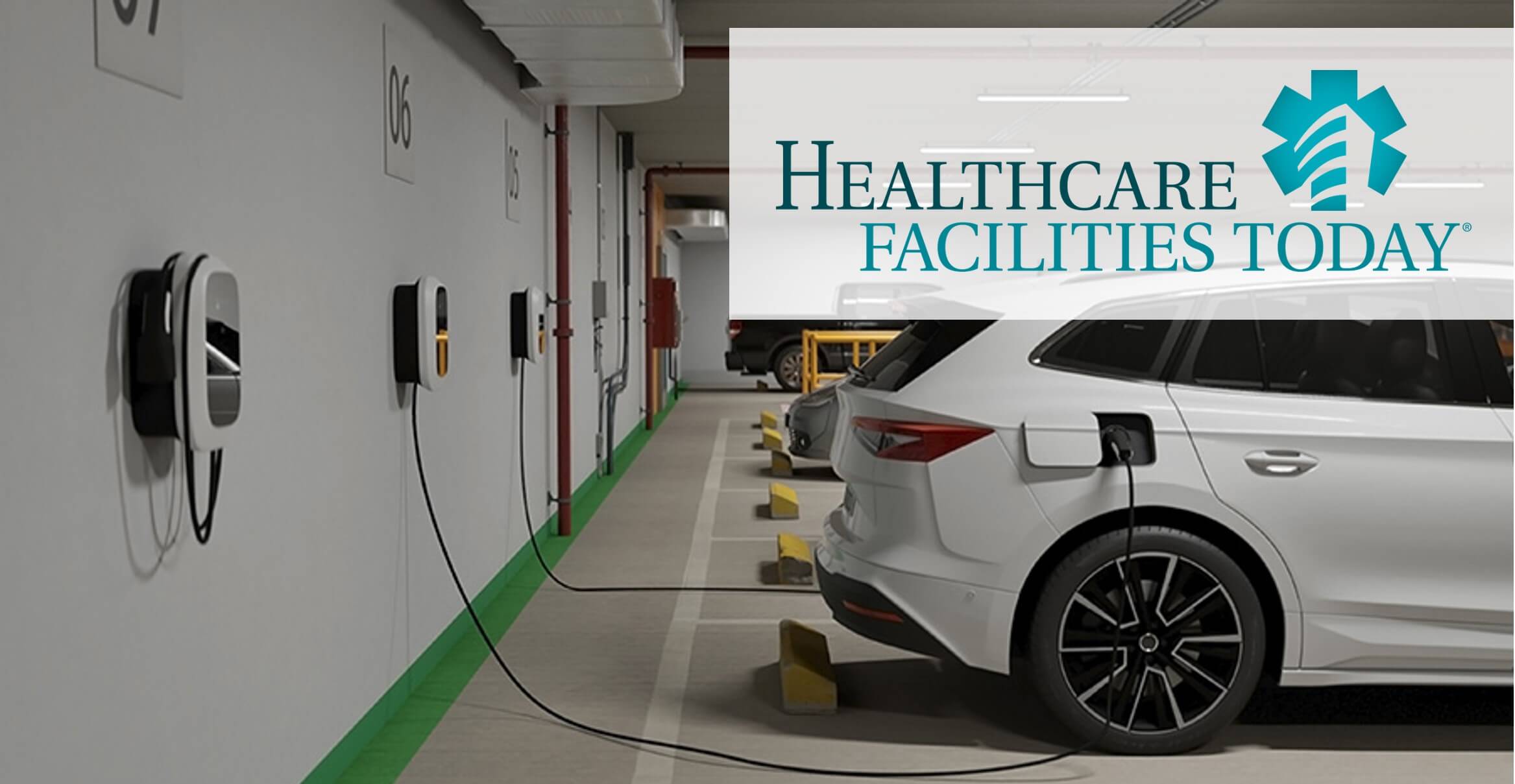
As electric vehicle adoption rises across the healthcare sector, hospitals and outpatient campuses are under pressure to provide reliable, accessible EV charging that supports the needs of patients, visitors, and employees. But unlike retail or office environments, EV infrastructure on a healthcare campus must meet a higher threshold: it must enhance – not impede – campus safety, patient access, and daily clinical operations.
In his follow-up article for Healthcare Facilities Today, Chris Cutcliff, Vice President of Operations at Chateau Energy, outlines how healthcare leaders can evaluate the next stage of EV charging deployment. The first article focused on protecting patient access during charger installation, this second piece expands, addressing the broader design and operational strategies that ensure EV charging remains safe, convenient, and adaptable as demand grows.
The central idea: installing chargers is not the finish line. Healthcare organizations must design infrastructure that supports safe circulation today while preparing for more vehicles, higher utilization, and greater charging capacity tomorrow.
Healthcare campuses operate in a dynamic environment where safety and convenience must be balanced with the realities of campus traffic, clinical schedules, and 24/7 operations.
Key challenges include:
EV drivers unfamiliar with the campus may navigate drop-off lanes, crosswalks, or parking aisles unpredictably. Strategic placement of chargers and clear signage help reduce confusion and potential conflicts.
Patients with mobility limitations, staff working long shifts, and visitors unfamiliar with the campus need charging options that are intuitive, visible, and accessible. Chargers hidden behind secondary lots or obstructed by construction zones create frustration and safety gaps.
While current utilization may be modest, healthcare organizations must assume increased EV adoption among employees and patients. Planning only for today’s needs creates operational bottlenecks tomorrow.
Chris’s article highlights that successful EV infrastructure is equal parts planning, design, safety, engineering, and operational foresight.
With experience deploying EV infrastructure across complex customer environments, Chateau Energy brings a mission-critical mindset to healthcare campuses, focusing on safety, uptime, and future readiness from the start.
We evaluate sightlines, pedestrian movement, ADA accessibility, and vehicle flow to ensure chargers never interfere with emergency activity or patient loading zones. Proper lighting, markings, and circulation design reduce potential hazards.
Chateau Energy considers how different users interact with the campus:
Charging should reinforce convenience and never add friction to an already stressful visit.
Chateau Energy designs with tomorrow in mind. That includes expansion-ready panels, conduit banks sized for additional chargers, flexible trenching layouts, and load-management strategies that avoid costly redesigns later.
Hospitals cannot pause operations for construction. Our teams coordinate closely with the healthcare facilities and operations teams to ensure installation is phased and sequenced to avoid congestion, downtime, or safety risks.
This mindset – safe today, scalable for tomorrow – is what positions healthcare leaders for long-term EV charging success.
What inspired the follow-up article:
After publishing the first installment (read EV Charging Station Design: Ensuring Patient Access), Chris and the Chateau Energy team answered the next wave of questions: “Once we know where EV charging should go, how do we plan for the right number of chargers, ensure safety, and prepare for expansion?” This follow-up article answers that next layer of complexity.
Why the topic matters now:
EV adoption forecasts point to significantly higher utilization on hospital campuses in the future. Early adopters may only see a handful of vehicles charging today, but the curve could be steep, and healthcare infrastructure must keep pace. Planning for scalable infrastructure now prevents costly re-routing, trenching, and facility disruption later.
What wasn’t covered in the original article:
This piece expands into the importance of electrical strategy, including power availability, load management, capacity planning, and integration with broader campus efficiency goals. Many healthcare facilities are exploring how to align EV charging infrastructure with distributed energy resources, resiliency planning, or future microgrid deployments. These strategic conversations will influence how EV charging fits into long-term facility planning.
Healthcare organizations are navigating a convergence of trends:
EV charging is no longer a single project. It should be looked at as an ongoing strategy.
Forward-thinking healthcare leaders understand that EV charging must be:
Chateau Energy partners with organizations nationwide to develop EV charging plans that align safety, operations, and long-term growth, Making Energy an Asset® rather than an obstacle.
Read the full article at Healthcare Facilities Today
Chateau Energy Solutions Making Energy an Asset®
Ready to get started on the path to energy efficiency and sustainability?