 Posted by Pam Hoddinott
  On Fri May 19
LED lights are commonplace today. You know what they are – the small lights that illuminate keyboards, computer screens, traffic lights, flashlights, and even car headlights. They also illuminate the inside and outside of businesses. One of the easiest ways an organization can improve its energy sustainability is with an LED lighting upgrade or retrofit.
LED lights have gained popularity in helping organizations with their sustainability strategy because they require less power and use less energy than conventional sources of light (fluorescent or halogen bulbs), thereby saving money and lowering carbon footprint. Installing LED lighting in facilities is a fast and simple way to reduce energy consumption.
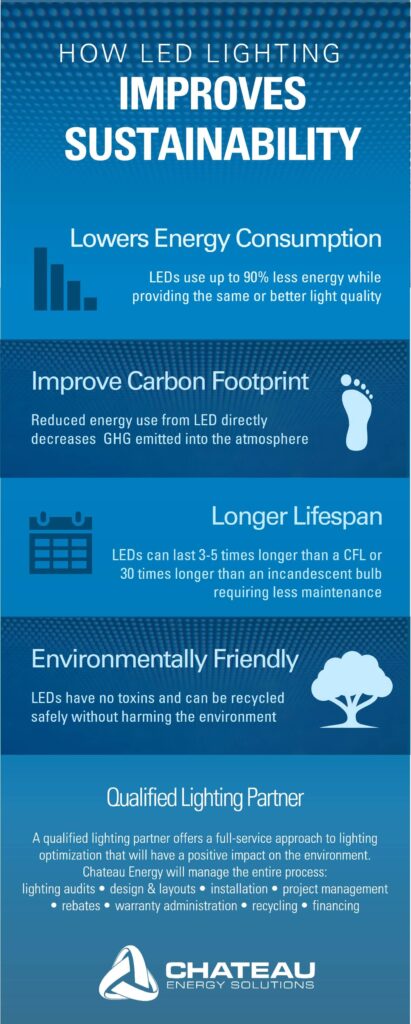
LEDs can use up to 90% less energy and last up to 25 times longer than traditional incandescent bulbs. Organizations that switch from traditional lighting sources see a significant reduction in monthly utility bills. In addition, businesses with high occupancy levels – such as restaurants or retail stores – will also benefit from reduced cooling costs. LEDs produce less heat than incandescent bulbs.
LED lighting has numerous environmental benefits. The most obvious is carbon footprint reduction since less energy is needed to power LED lights. Reducing electricity consumption can also reduce the greenhouse gas emissions associated with a facility’s energy use, supporting broader sustainability and carbon-reduction goals.
LED lights have a much longer lifespan than traditional bulbs. They also require less maintenance and are more durable overall. This is especially important for businesses that depend on their lighting systems to function properly at all times. Retail stores or manufacturing plants cannot continue business without proper lighting.
LED lighting typically requires less frequent replacement than many conventional lighting technologies, helping reduce both product replacement and ongoing maintenance costs.
Labor or maintenance costs associated with replacing traditional lamps are also significantly lowered, with staff spending less time replacing burned-out lamps. Maintenance personnel can focus their time on other sustainable energy solutions.
Traditional lighting technologies, including fluorescent lamps, can contain small amounts of mercury, which makes proper handling and disposal important. When these lamps are thrown away or not recycled correctly, they can contribute to environmental contamination. LEDs do not contain mercury, which is one reason they are considered a better environmental choice. Even so, LED products should still be recycled responsibly to reduce waste and recover valuable materials.
Improvements don’t have to end there. Organizations can also pair LED lighting with controls such as occupancy sensors, scheduling, dimming, and daylight-responsive controls to create additional opportunities for energy savings.
Chateau Energy evaluates lighting needs based on the facility, application, operating hours, and how each space is used. From there, we identify the combination of lighting and controls that can improve lighting quality, reduce energy use, and lower ongoing maintenance costs.
A qualified lighting partner can offer a full-service approach to lighting optimization that will have a positive impact on the environment. Chateau Energy provides expertise on everything from lighting audits, design and layouts, and installation to project management, rebate and warranty administration, and recycling. Numerous case studies can be read here highlighting our proven lighting upgrade and retrofit expertise and sustainable energy solutions.
Before starting an LED lighting upgrade, organizations should evaluate how each space is used, current fixture performance, operating hours, lighting quality, maintenance needs, and any controls that may improve efficiency. A lighting assessment can help determine whether a full retrofit, targeted fixture replacement, or a phased upgrade makes the most sense.
LED lighting upgrades can support sustainability goals by reducing electricity consumption and greenhouse gas emissions associated with facility energy use. Longer-lasting LED fixtures can also reduce the frequency of lamp and fixture replacement, which may help reduce material use and waste over time. Organizations can document baseline conditions and estimated or measured energy savings to demonstrate the project’s contribution to broader energy and sustainability goals.
LED lighting can be a practical way for organizations to reduce energy use, lower associated greenhouse gas emissions, and make measurable progress toward broader sustainability goals. When the lighting strategy is designed around how the facility operates, organizations can improve lighting performance while reducing the energy required to support their buildings.
Contact Chateau Energy for your LED lighting upgrade or retrofit needs.
Last updated on 9-17-2026
Chateau Energy Solutions Making Energy an Asset®
Whether you need to fast-track power for a new facility, upgrade hundreds of sites, or electrify your fleet, Chateau Energy helps you reach your energy goals faster and smarter.