 Posted by Luca Giordano
  On Thu May 21
Author: Luca Giordano, Sales Engineer, Key Accounts, Chateau Energy Solutions
Data center teams know the pressure that comes with medium-voltage equipment lead times. Once a project schedule is tied to switchgear, transformers, protection relays, or utility interconnection milestones, procurement stops being a purchasing exercise. It becomes part of the critical path.
That is why many developers are addressing MV equipment earlier. They are asking better questions during preconstruction. They are trying to lock in production slots before the schedule gets compressed. They are using OFCI strategies to gain more control over equipment that cannot be treated like a commodity.
That shift is changing how developers approach schedule-sensitive infrastructure. But securing equipment sooner is only part of protecting data center energization.
A purchase order does not mean the equipment is buildable as specified. It does not mean submittals will move quickly, the manufacturer’s production schedule will stay aligned with construction’s, or that deliveries are going to match up perfectly with site readiness. And, probably most notably, it does not mean the project will be ready to install, commission, and energize when the equipment arrives.
For data center developers, the real objective is not getting MV equipment ordered. The real objective is getting the facility energized without avoidable delays.
Medium-voltage equipment often becomes one of the most schedule-sensitive components during data center development. This infrastructure is highly specialized and closely tied to utility requirements, engineering design, installation sequencing, and commissioning milestones. When these critical milestones are delayed, project teams lose valuable flexibility and the ability to proactively resolve issues before they impact energization timelines.
That typically turns up in predictable ways. A preferred manufacturer may not have production availability. A specification may require equipment that cannot be delivered within the construction schedule. A utility requirement may not be reflected in the equipment package. A submittal review may surface technical conflicts that should have been resolved months earlier.
By the time the issue is visible to the broader project team, the schedule is often already under pressure.
This is one reason Owner Furnished Contractor Installed (OFCI) has become more relevant in data center development. With an OFCI approach, the owner can secure critical equipment earlier instead of waiting for the traditional construction procurement cycle to catch up. Done well, OFCI gives the developer more control over the equipment strategy, the purchasing timeline, and the manufacturer relationship.
But OFCI is not simply an earlier buying mechanism. It needs to be managed. Without active coordination, OFCI can simply shift procurement risk into execution risk. I often have this discussion with data center developers before procurement decisions are made. Getting the right MV equipment when the project needs it is important, but it only creates value if the equipment, design, utility requirements, and commissioning plan all move together.

Once MV equipment is ordered, a new phase of work begins. This is where schedule protection becomes less visible but just as important. Specification alignment is the first issue.

Data center projects move fast and design details evolve. If the medium-voltage equipment package was built around an early version of the design, someone needs to make sure the final requirements are still reflected before production advances too far.
Submittals are another common pressure point. They look administrative from the outside, but they are where technical questions, exceptions, clarifications, and approvals can slow momentum. A delayed submittal package can affect production timing. A technical revision can require new drawings. A missed review cycle can push the schedule when no one expected it.
Manufacturer coordination requires more than a promised delivery date. Production slots, factory drawings, engineering questions, material availability, testing windows, and shipping commitments all require active communication. The project team needs visibility into whether the delivery date is still realistic and what might put it at risk.
Delivery timing must be managed against site readiness. Equipment that arrives early creates storage, handling, and protection issues. Equipment that arrives late delays installation and downstream work. The delivery date has to fit the construction sequence, not just the procurement schedule.
Finally, energization readiness ties everything together. MV equipment connects to a broader electrical system. Utility coordination, installation sequencing, testing, commissioning, and documentation all need to come together. If any one of those pieces is not ready, the project can still miss its energization target.
The team that stays involved after procurement is the one that really protects the schedule.
The most frustrating delays are the ones that happen after everyone thought the risk was solved. The MV equipment was ordered. The production slot was secured. The schedule looked protected, then the project loses time anyway.

Sometimes the issue is technical. A piece of equipment does not match a final requirement. A relay setting, enclosure configuration, or utility interface needs clarification. The issue may be resolved, but if it is discovered late, it affects production or installation timing.
Sometimes the issue is sequencing. The equipment is ready, but the site is not. Or the site is ready, but the equipment is still working through factory testing. On a mission critical project, sequence matters because multiple teams are working toward the same energization window.
Sometimes the issue is visibility. The data center project team may not realize there is a problem until the manufacturer misses a milestone, a production update slips, or a critical engineering clarification surfaces late in the process. By that point, options are often limited, and schedule recovery becomes significantly more difficult. Without consistent communication and active coordination between the manufacturer, engineering teams, contractors, and ownership groups, small issues can quickly develop into larger delays that impact installation, commissioning, and energization timelines.
And sometimes the issue is that no one owns the full path from equipment strategy to energization.
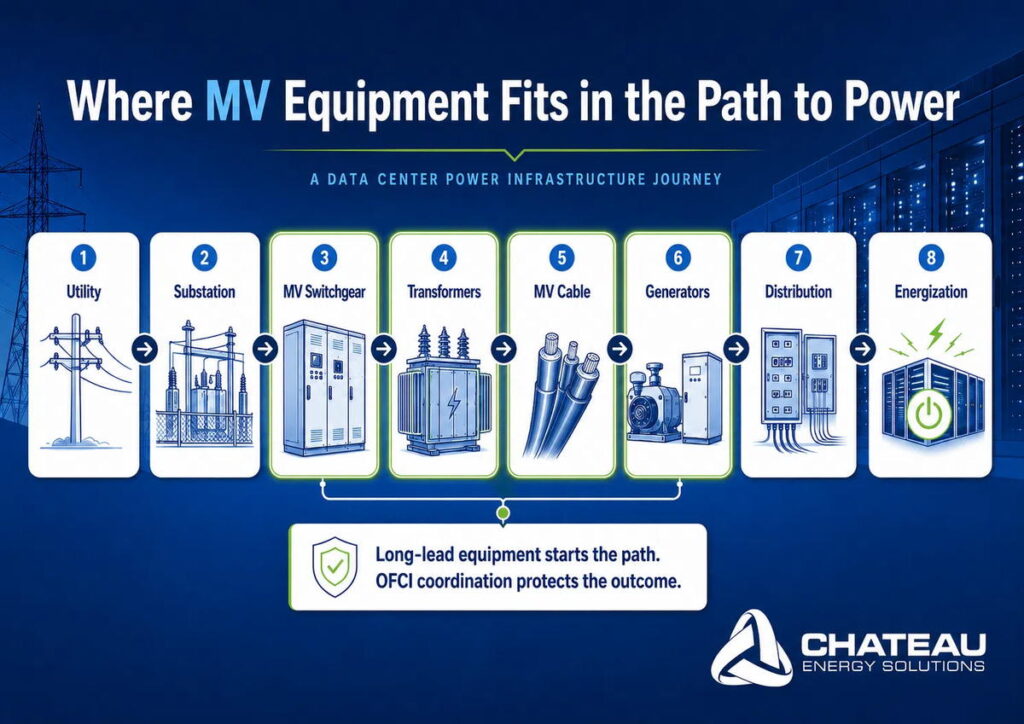
That ownership matters because MV infrastructure is not isolated. It sits inside a larger power strategy that connects utility service, substations, switchgear, transformers, generators, UPS systems, distribution equipment, and commissioning plans. A decision in one area affects the others.
The value of staying engaged after procurement becomes clear when a project hits an unexpected challenge.
For one national data center co-location provider developing a new remote campus with aggressive go-live timelines, the challenge was not just lead time. The site’s remote location made large onsite labor crews costly and difficult to coordinate. The developer needed MV infrastructure deployed fast, with minimal field labor, and without sacrificing redundancy or reliability. Chateau Energy provided an OFCI solution and engineered a rapid-deployment, skidded MV infrastructure package by drawing on deep manufacturer relationships and expertise in both utility-grade distribution and modular deployment. The team integrated MV switchgear, transformers, and advanced controls into a pre-assembled, factory-tested skid, standardized interfaces to minimize field wiring and commissioning time, and enabled parallel fabrication to compress construction timelines.
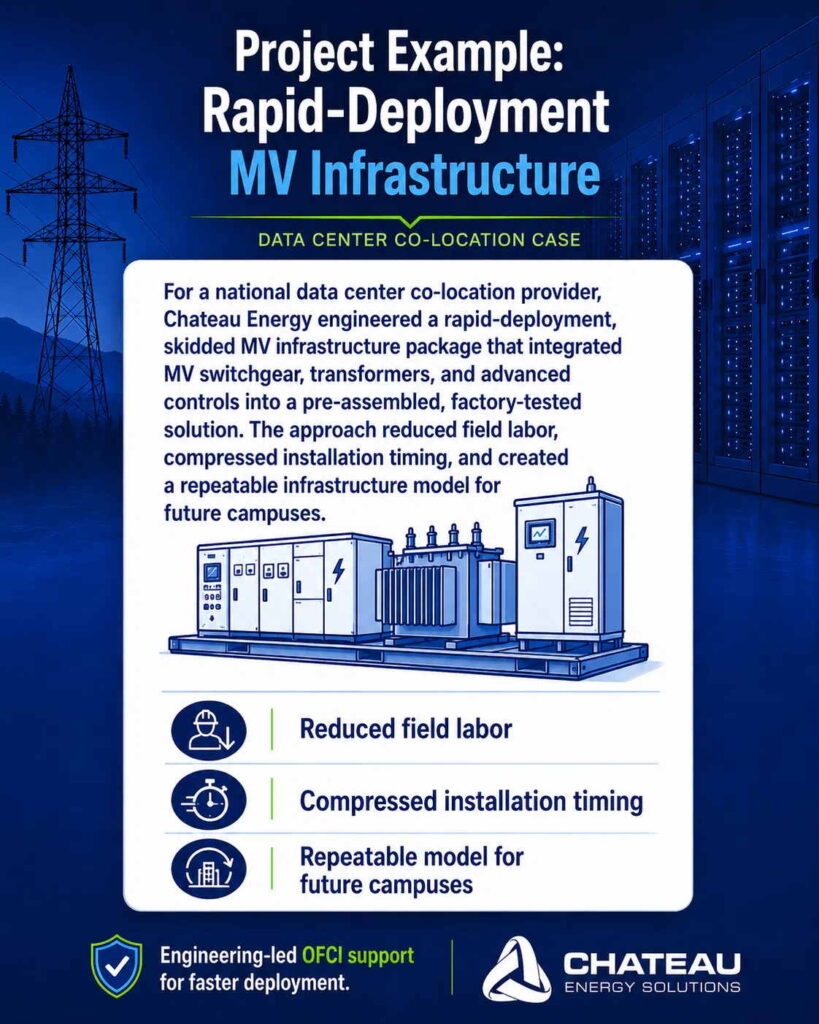
The outcome: installation completed in weeks instead of months, the developer eliminated standby diesel generators due to advanced switching and load-transfer capabilities, and the client walked away with a repeatable, scalable MV infrastructure approach it can deploy across future campuses.
That story matters not because it was complex. It matters because it shows what engineering-led, post-procurement coordination can make possible. Chateau Energy was not just sourcing equipment. The team was managing the full path from strategy to power-on.
The same thinking applies when something goes wrong during construction.
In a separate case, a data center developer faced a catastrophic failure of critical MV switchgear late in the project, threatening commissioning and go-live timelines. With industry lead times for switchgear approaching 150 weeks, the original equipment path was not viable.
Chateau Energy’s team stepped in and evaluated the developer’s broader MV equipment portfolio, identified equipment that could be reallocated without affecting another site’s schedule, and helped preserve the original commissioning timeline. That level of response depends on visibility and relationships that had to exist before the crisis.
OFCI gives data center owners more control over equipment timing. That is one of its most important advantages. But OFCI only delivers that value when the owner-furnished equipment is managed with the same discipline as the rest of the project.
Without that discipline, OFCI can create a new problem: the owner controls the purchase, but no one is fully managing the details between procurement and installation.
A strong OFCI program should be able to answer questions like these throughout the project:
These are not procurement questions. They are project execution questions. And they require ongoing engagement, not just a purchase order.
Chateau Energy’s role in OFCI program management reflects that reality. The team brings MV infrastructure knowledge, manufacturer relationships, utility coordination experience, engineering alignment capability, and program management depth. That combination is valuable because the work does not fit neatly into one category. It is procurement, but it is also technical. It is schedule management, but it is also infrastructure strategy. It is manufacturer coordination, but it is also commissioning readiness.
Before a data center project team assumes the schedule is protected, these questions are worth asking:
If the answers to those questions are unclear, risks to the schedule have not been resolved, only deferred.

Data center power infrastructure is complex because no single piece of equipment determines success. Medium-voltage switchgear, transformers, cable, utility coordination, generators, UPS systems, distribution equipment, installation sequencing, and commissioning milestones all have to work together.
Securing MV equipment sooner is a critical first step. It reduces lead time risk and gives the project team more control over one of the most schedule-sensitive elements of the build. But energization depends on what happens next.
The project team still needs to manage specifications, submittals, manufacturer coordination, delivery logistics, installation sequencing, and commissioning readiness. Every one of those steps can protect the schedule or put it at risk. Every handoff between teams is a potential gap.
That is why procurement should not be treated as the finish line. It should be treated as the start of a more disciplined phase of coordination.
For data center developers, the strongest path is not simply buying equipment earlier. It is bringing in a partner who understands the full path from MV equipment strategy to energization, and who stays involved long enough to help manage it.
That is where Chateau Energy starts Making Energy an Asset®.
Chateau Energy Solutions helps data center teams manage mission critical infrastructure, medium-voltage equipment strategy, OFCI program management, and the coordination required to move from procurement to energization with confidence.
Talk to Our Mission Critical Infrastructure Team
Medium-voltage equipment is often tied directly to a data center’s energization timeline. If switchgear, transformers, MV cable, or related infrastructure are delayed, the project may not be able to complete installation, testing, commissioning, or utility coordination on schedule.
OFCI stands for Owner Furnished Contractor Installed. In data center projects, it allows the owner or developer to procure critical equipment directly while the contractor handles installation. This approach can help owners secure long-lead equipment earlier and maintain more control over schedule-sensitive infrastructure.
No. Early procurement reduces lead time risk, but energization still depends on specification alignment, submittals, manufacturer coordination, delivery timing, installation sequencing, utility coordination, and commissioning readiness. Those steps have to be actively managed after the purchase order is issued.
Chateau Energy combines MV infrastructure experience, manufacturer relationships, OFCI program management, engineering coordination, and mission critical expertise. The team helps data center developers manage not just equipment procurement, but the full path from early equipment strategy through energization and long-term operational support.
Sales Engineer, Key Accounts
Chateau Energy Solutions
Luca Giordano is a Sales Engineer for Key Data Center Accounts at Chateau Energy Solutions, supporting mission critical electrical infrastructure solutions for the data center industry. With a Bachelor of Engineering in Electrical and Electronics Engineering and experience selling electrical services and equipment, Luca brings both technical understanding and a client-focused perspective to his role.
His background includes inside and outside sales engineering roles supporting customers in mission critical environments. Luca works closely with data center clients to understand infrastructure needs, support project priorities, and help move complex electrical solutions from early discussions into execution. Outside of work, he enjoys shooting over 100 in golf, playing sports, trying new foods, and traveling with family and friends. Connect with Luca on LinkedIn.
Chateau Energy Solutions Making Energy an Asset®
Whether you need to fast-track power for a new facility, upgrade hundreds of sites, or electrify your fleet, Chateau Energy helps you reach your energy goals faster and smarter.