 Posted by Chris Byerly
  On Thu May 21
Author: Chris Byerly, Director of Business Development, Chateau Energy Solutions
Most companies do not delay LED lighting upgrades because they think lighting is unimportant. They delay because the lights still turn on.
That sounds simple, but it is usually where the issue starts. A facility can operate for years with inconsistent light levels, outdated fixtures, high maintenance demands, and exterior areas that do not have the lighting quality they should. The system is not broken enough to create a crisis, so the upgrade keeps moving to the next budget cycle. The problem is that waiting rarely keeps costs flat. Energy use, maintenance needs, inconsistent light levels, and missed rebate opportunities continue while the project sits.
I have seen this across healthcare facilities, industrial plants, warehouses, retail sites, hospitality properties, offices, and multi-site portfolios. The facility teams usually know where the problems are. They know which fixtures fail the most, which parking areas are too dark, and which corridors, production areas, or patient spaces feel unevenly lit. What they often do not have is the time, data, internal alignment, or project support to turn that knowledge into completed work.
That is the real reason many LED lighting upgrades stall. The opportunity is there, but the path forward is not clear enough.
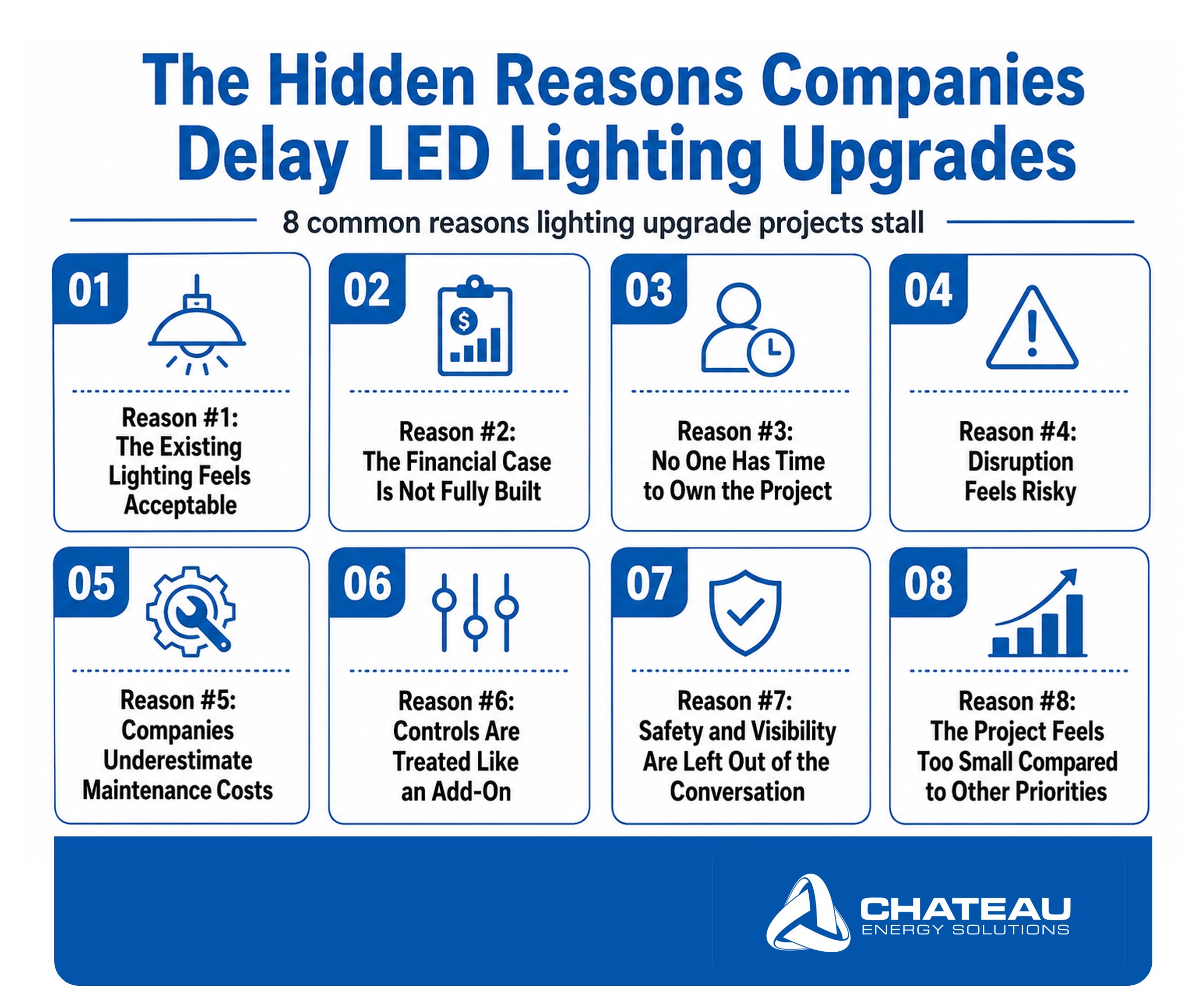
Lighting is one of those systems people adjust to over time. Employees get used to dim areas. Facility teams get used to replacing lamps, ballasts, drivers, or mismatched fixtures. Production teams work around shadows, glare, or inconsistent light levels because the building still functions.
That can make lighting upgrades easy to defer.
The problem is that “acceptable” lighting can still be expensive lighting. Older systems may use more electricity than necessary, require more frequent maintenance, and create inconsistent conditions across the facility. Throughout a portfolio, those issues rarely show up the same way from site to site. Some facilities may have new fixtures, others may still be operating with outdated lamps, and exterior lighting may have been upgraded on sections over time. Before you know it, the building portfolio looks patchworked, performs inconsistently, and becomes harder to manage.
The companies that move forward with LED Lighting upgrades usually start by changing the question. Instead of asking whether the lights still work, they ask whether the current system is helping the facility operate the way it should.
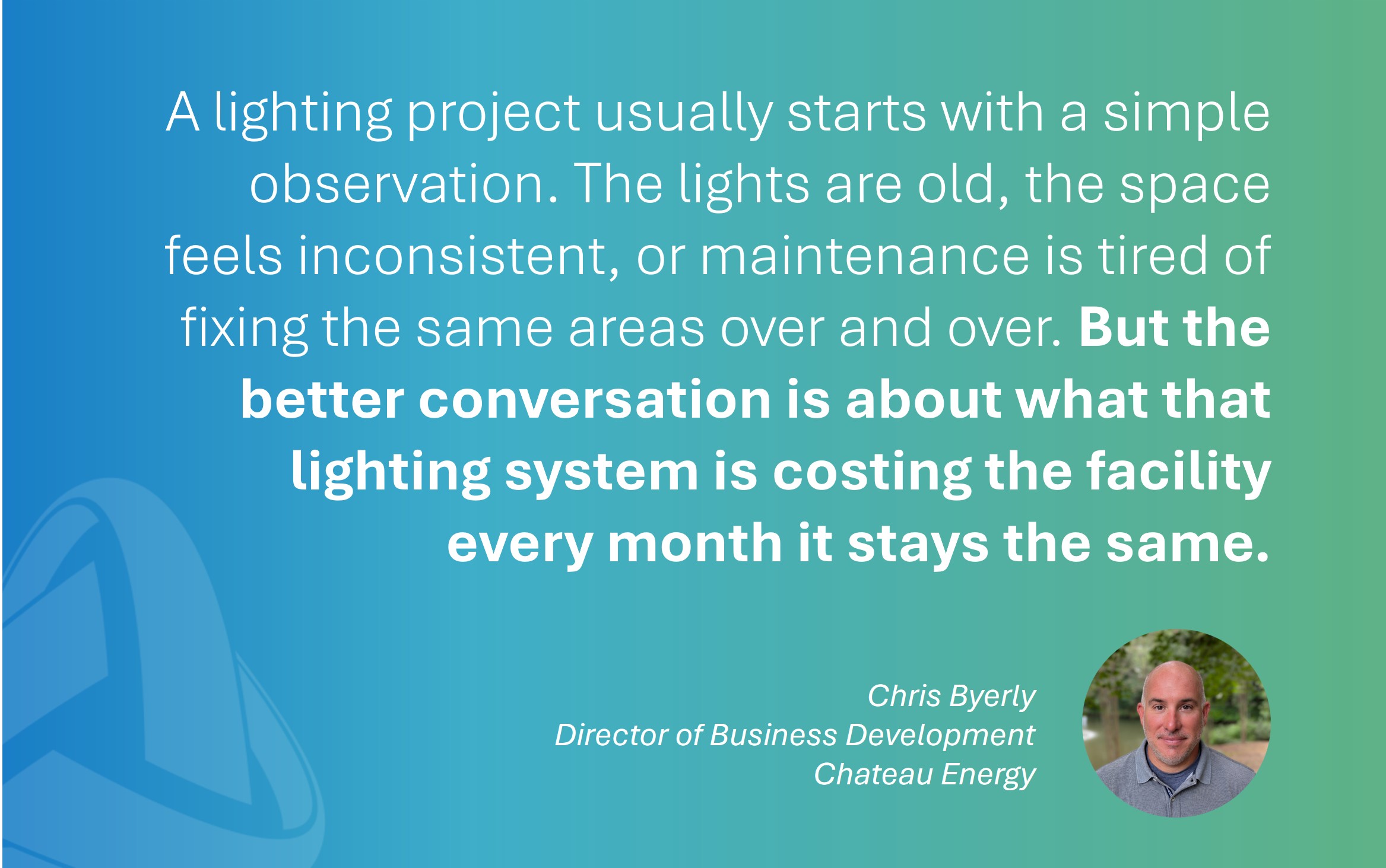
I often think about it this way: A lighting project usually starts with a simple observation. The lights are old, the space feels inconsistent, or maintenance is tired of fixing the same areas over and over. But the better conversation is about what that lighting system is costing the facility every month; it stays the same.
Most decision makers understand that LED lighting can save energy. That alone does not always move a project forward.
For a CFO, VP of Operations, or portfolio leader, “this will save energy” is only part of the story. They need to understand the project cost, expected savings, utility rebate opportunity, maintenance reduction, payback, operating impact, and implementation plan. They also need confidence that the numbers are grounded in the actual facility, not a generic estimate.
Lighting is worth that level of attention. ENERGY STAR states that lighting accounts for 17% of all electricity consumed in U.S. commercial buildings, which means it can represent a meaningful operating-cost opportunity for many facilities.
ENERGY STAR also notes that LED lighting can use significantly less electricity than traditional bulbs and can last much longer, creating savings in both energy and operations and maintenance.
This is where many upgrades lose momentum. The facility team sees the need. Finance wants more detail. Procurement needs scope clarity. Operations wants to know how the installation will affect the building. Sustainability may want emissions data. No one is against the project, but no one has enough information to approve it.
The U.S. Department of Energy’s LED Adoption Report shows why this matters at a larger scale. DOE estimated that LED adoption produced 1.3 quadrillion Btu in annual U.S. energy savings in 2018, equal to $14.7 billion in consumer cost savings.
For individual companies, the takeaway is practical: lighting savings are real, but they need to be translated into a facility-specific business case. That includes the cost of waiting.
A lighting upgrade can touch a surprising number of departments.
Facilities may identify the problem. Finance may approve the budget. Procurement may need vendor comparisons. Operations may set installation windows. Sustainability may track the energy and carbon impact. Corporate leadership may want consistency across sites.
That many stakeholders can be helpful once a project is moving. Early on, it can slow everything down.
In a single facility, the project may stall because the facility manager is already managing repairs, contractors, inspections, occupant needs, and capital planning. In a multi-facility rollout, the challenge grows. Each site may have different fixture types, ceiling heights, operating hours, local utility programs, access requirements, and internal approval processes.
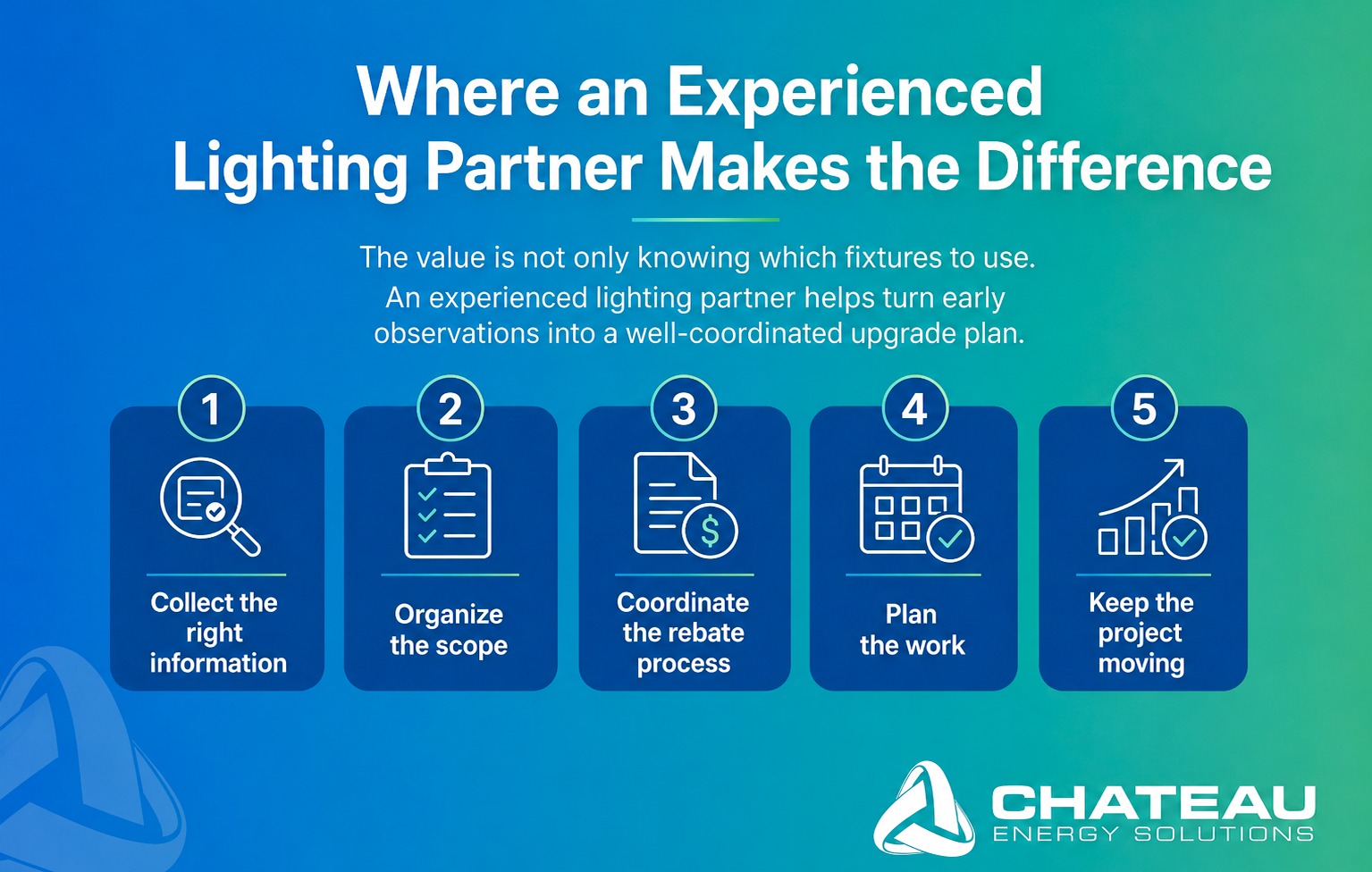
This is where an experienced lighting partner can make a meaningful difference. The value is not only knowing which fixtures to use. It is knowing how to collect the right information, organize the scope, coordinate the rebate process, plan the work, and keep the project moving after the first conversation.
For many facilities, the concern is not whether the lighting upgrade will work. The concern is whether the installation will disrupt the business.
That is especially true in healthcare, manufacturing, hospitality, retail, logistics, and 24/7 operations. Patient areas cannot be treated like empty office space. Production floors cannot shut down casually. Retail locations may need work completed before opening or after closing. Warehouses need safe access around equipment, racking, loading areas, and vehicle movement.
This is one of the reasons Chateau Energy looks closely at implementation early. The best lighting plan on paper can still frustrate the client if materials show up at the wrong time, crews interrupt operations, or the facility team has to solve problems the contractor should have anticipated.
In Chateau Energy’s work with Encompass Health, implementation planning was central to the program. The national LED lighting program required a customized turnkey solution, careful construction logistics, and a plan to minimize disruption to rehabilitation personnel and patients. Chateau Energy has completed more than 75 LED lighting projects for Encompass Health to date, with the facility lighting upgrades generating more than $2.3 million in estimated annual energy savings and more than $510,000 in avoided capital costs through utility rebates.
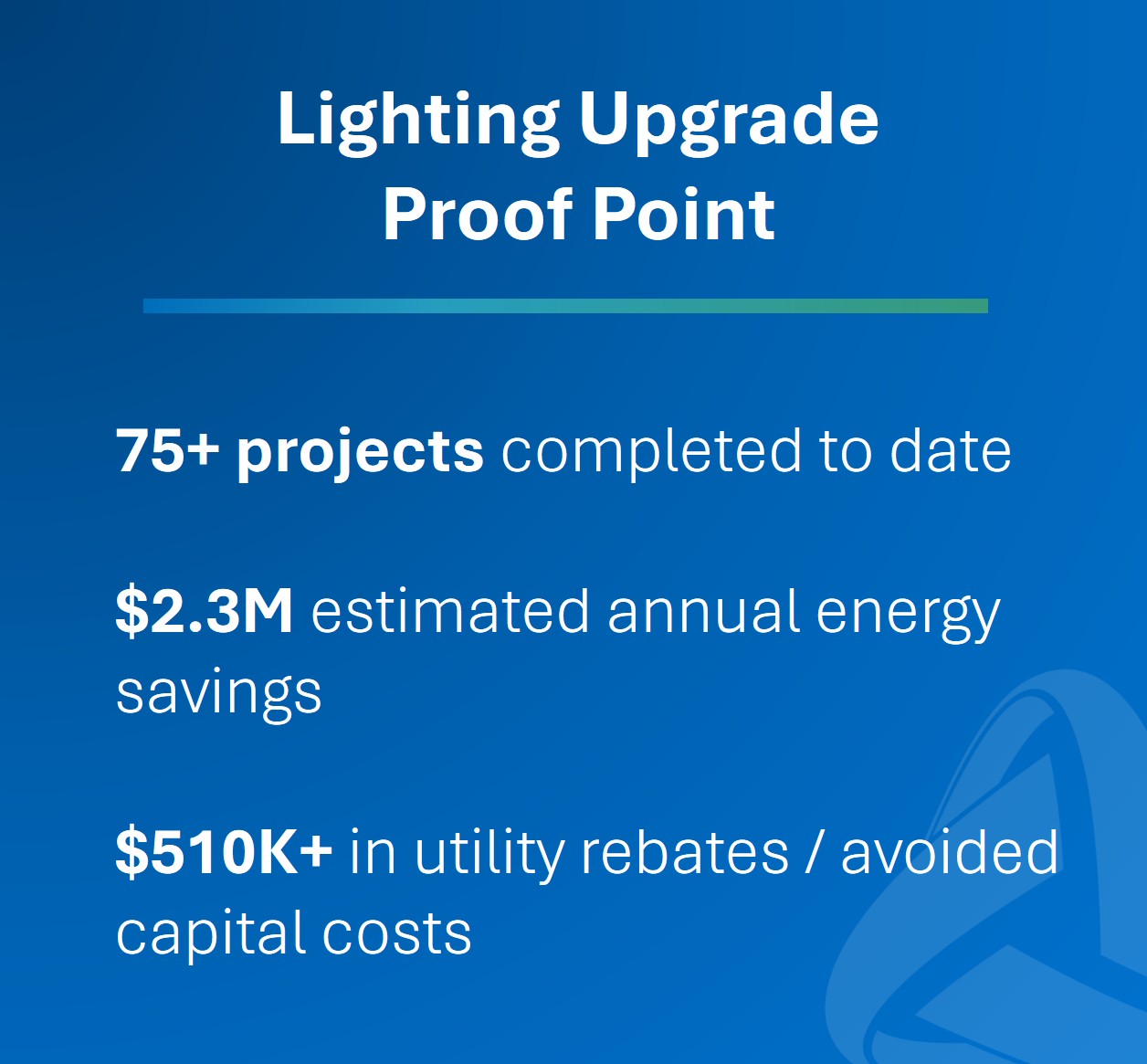
That is the kind of proof point that matters because it shows the real work behind the savings. Multi-site lighting programs are not just about product selection. They are about planning, scheduling, communication, rebate administration, and execution across active facilities.
Energy savings usually get the attention, but maintenance can be just as important.
Older lighting systems create small problems that add up. A lamp replacement here, a ballast issue there, and then add in a lift rental, labor, repeat service calls, and inconsistent replacement products. Areas never end up looking quite right because fixes happened one fixture at a time.
In large facilities, high ceilings or difficult-to-access areas make this even more expensive. In multi-site portfolios, the maintenance burden becomes harder to see because the costs are spread across locations and budgets.
I often see this when reviewing existing systems:
When talking with facility or operations people, I have found that energy savings may open the door, but maintenance is often what gets the facility team’s attention. If they are constantly sending people back into the same areas, the lighting system is already taking more time and money than it should.
A good lighting assessment should look at more than wattage. It should consider maintenance records, fixture condition, access needs, operating hours, replacement availability, and whether a more standardized system could reduce ongoing service headaches.
Once those costs are separated into energy, maintenance, visibility, controls, and implementation timing, the project usually looks less like a nice-to-have and more like a practical operating decision.
Controls are one of the most common missed opportunities in lighting upgrades.
A facility may replace fixtures and leave controls mostly unchanged, or controls may be installed but never fully commissioned. Too often we see that occupancy sensors may not match how the space is used, schedules have not been updated, and daylight harvesting has been ignored. Also, exterior lighting may run longer than needed because no one revisited the settings.
That is where value gets left behind.
The U.S. Department of Energy notes the broader potential of connected lighting. In its LED Adoption Report, DOE stated that connected lighting controls represented only 0.2% of lighting installed, but estimated that connected controls could contribute 1.1 quads of annual LED energy savings if fully implemented.
Research from the DesignLights Consortium also shows that networked lighting controls can create additional energy savings beyond LED fixture upgrades when strategies such as occupancy sensing, scheduling, daylight harvesting, and high-end trim are properly applied. The keyword is “properly.” Controls only deliver value when they are matched to how the facility operates and commissioned so the system works as intended. That does not mean every facility needs the most complex control system available. It means controls should be considered intentionally.
The right approach depends on the space, operating hours, user needs, maintenance capabilities, and budget. A warehouse aisle, patient corridor, manufacturing floor, parking lot, office, and hotel back-of-house area should not all be treated the same. Controls should support how the space is actually used, not create a system that the facility team has to fight after installation.
Safety is also worth addressing, especially in spaces where visibility affects how people navigate, work in, and secure a facility.
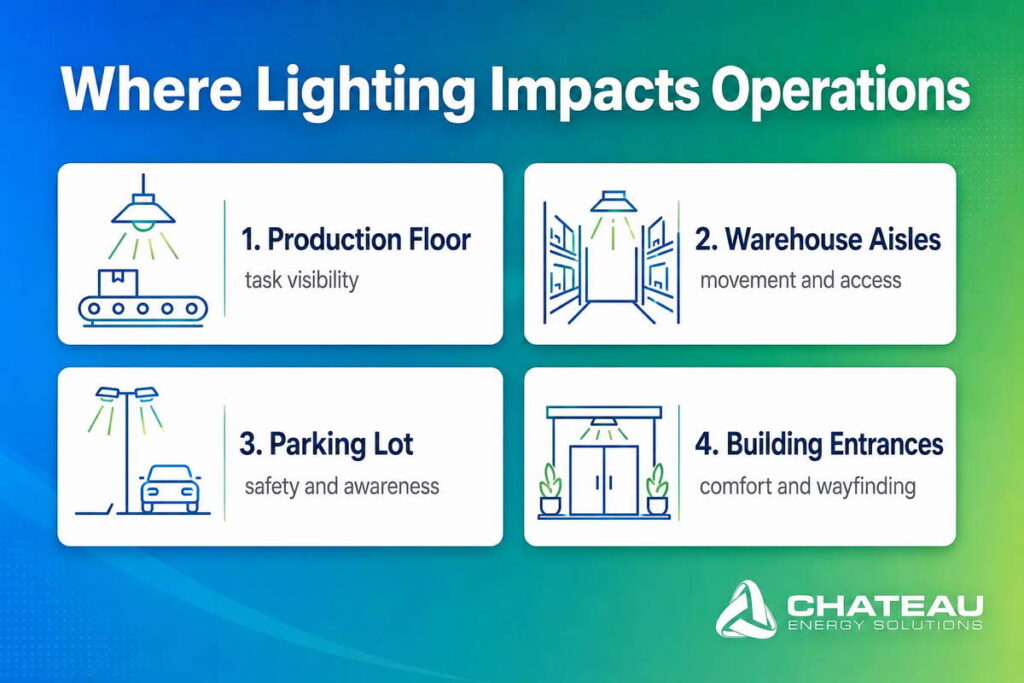
In an industrial facility, lighting can influence how clearly employees see equipment, materials, labels, work surfaces, and travel paths. In a warehouse, it can affect aisles, loading areas, forklift movement, pedestrian zones, and maintenance tasks. Outside the building, parking lots, walkways, entrances, storage areas, and loading docks all depend on proper lighting for visibility and security.
This is one of the reasons lighting upgrades should be evaluated by space and by use. A production floor, patient corridor, parking lot, and warehouse aisle do not need the same lighting approach. Each area has its own purpose, traffic patterns, visibility needs, and operating conditions.
There are also standards and resources that reinforce the importance of lighting in work environments. OSHA’s construction illumination standard includes minimum foot-candle requirements for work areas such as warehouses, corridors, hallways, exitways, plants, shops, offices, and storage areas while work is in progress.
For exterior areas, the U.S. Department of Energy’s Better Buildings resource on exterior lighting discusses energy savings, security, and safety considerations for outdoor lighting applications.
For facility teams, this is where the value of lighting can become very tangible. Better visibility can support safer work areas, more secure parking lots, and better protection for equipment, vehicles, inventory, and people moving through the site.
Chateau Energy saw this clearly in its LED lighting upgrade at Heatec’s 135,000-square-foot manufacturing plant. The project included nearly 1,000 LED lights across interior and exterior spaces, reduced annual energy use by 365,000 kWh, and improved light quality, creating a brighter and safer work area.
Energy efficiency lighting upgrades often compete with larger capital projects: HVAC replacements, roof work, electrical upgrades, production investments, renovations, or new construction.
That can make lighting feel less urgent.
The mistake is assuming a less complex project has less value. Lighting is often one of the more practical energy efficiency projects to evaluate, approve, and execute. It can also create visible improvements employees, patients, guests, or customers notice right away.
ENERGY STAR describes lighting upgrades as a strong first step for improving commercial building energy efficiency, especially for buildings with inefficient lighting such as incandescent, halogen, HID, or T12 fluorescent systems.
For organizations trying to reduce energy waste without waiting on a major infrastructure project, lighting can be a smart place to begin. The key is to approach it with the same discipline as any other capital project.
A delayed project usually needs more than another reminder. It needs structure.
Start with the current condition of the lighting system. Look at fixture types, light levels, operating hours, maintenance issues, exterior areas, controls, and utility costs. For multi-site organizations, compare locations so facilities can be prioritized by where the opportunity is the strongest.
Then build the business case. Energy savings matter, but they should be presented alongside maintenance savings, rebate opportunities, operating impact, safety and visibility considerations, and the expected implementation timeline.
After that, plan the work around the facility. A lighting upgrade in a hospital, industrial plant, warehouse, retail store, or hotel should be scheduled around how that facility actually operates. Access, storage, disposal, crew scheduling, occupant communication, and quality control all matter.
Finally, make sure someone is responsible for keeping the project moving. That may sound basic, but it is often the difference between a completed upgrade and another report sitting in a folder.
This is where Chateau Energy’s role becomes valuable. We help clients assess the opportunity, define the scope, coordinate rebates, plan procurement, manage implementation, and execute the work across one facility or many. Our team understands the details that can slow a lighting project down because we have worked through them before.
LED lighting upgrades are easy to postpone because the need does not always feel urgent. The lights still work. The building is open. The maintenance team keeps things moving.
But delay has a cost.
You’ll see it in utility bills, maintenance time, inconsistent spaces, missed rebates, poor visibility, and projects that never quite make it from discussion to execution.
The good news is that most lighting delays are solvable. With the right assessment, business case, and project ownership, companies can move from “we should look at this” to completed work that improves how the facility operates.
For Chateau Energy, that is the bigger value of a lighting upgrade. It is not just a fixture change. It is a practical way to reduce energy waste, improve building performance, support the people using the space, and make energy a better asset for the business.
Ready to move your LED lighting upgrade from “someday” to completed work?
Chateau Energy Solutions helps facility and operations teams assess lighting opportunities, build the business case, coordinate rebates, manage implementation, and deliver LED lighting upgrades across individual facilities and multi-site portfolios.
Companies often delay LED lighting upgrades because the existing lighting still works, the savings have not been fully quantified, internal ownership is unclear, or leaders are concerned about disruption during installation.
Yes. Many facilities have older LED systems, inconsistent fixture types, poor light levels, or controls that were never fully optimized. An assessment can determine whether the current system is delivering the expected energy, maintenance, and operational value.
A commercial or industrial LED lighting upgrade should include a lighting audit of current conditions, fixture recommendations, light level review, controls strategy, utility rebate evaluation, financial analysis, implementation planning, and post-installation follow-through.
Chateau Energy Solutions helps organizations evaluate, plan, and execute LED lighting upgrades across individual facilities and multi-site portfolios. That includes audits, design support, rebate coordination, procurement, project management, implementation planning, and full installation.
Chris Byerly
Director of Business Development, Chateau Energy Solutions
Chris Byerly is the Director of Business Development at Chateau Energy Solutions, where he helps clients develop and execute energy-efficiency and EV-charging infrastructure projects. With nearly 20 years of experience consulting, designing, and selling energy efficiency projects and programs, Chris has worked with customers across multiple industries throughout the U.S.
His background includes deep knowledge of lighting, electrical infrastructure, sustainability-focused upgrades, and the manufacturer, distributor, and contractor relationships that help projects move forward. Outside of work, Chris spends his time playing or coaching rugby, a sport that has given him plenty of stories and a few bruises to go with them. Connect with Chris on LinkedIn.
Chateau Energy Solutions Making Energy an Asset®
Whether you need to fast-track power for a new facility, upgrade hundreds of sites, or electrify your fleet, Chateau Energy helps you reach your energy goals faster and smarter.