 Posted by Chris Byerly
  On Fri Jun 19
The right LED lighting upgrade partner should evaluate the facility before recommending products.
A strong partner looks beyond fixture counts to understand operating hours, mounting conditions, light levels, maintenance issues, safety needs, utility rebate eligibility, and how the space is actually used.
The lowest-cost proposal is not always the best project value.
A lighting upgrade or retrofit should be evaluated on total value, including energy savings, maintenance reduction, rebate opportunities, installation planning, warranty support, and long-term performance.
Installation planning is just as important as product selection.
For active facilities, the partner should know how to schedule work around production, patient care, customer areas, loading times, security requirements, and other operational needs.
A true lighting partner supports the full path from evaluation through closeout.
The right LED upgrade partner helps with audits, design, financial modeling, rebates, project management, installation coordination, documentation, warranty administration, and ongoing support.
Choosing an LED lighting upgrade or retrofit partner is not the same as choosing a fixture package.
By the time most facility, operations, energy, or procurement teams begin evaluating providers, they usually understand the basic reason to consider an LED upgrade. Outdated lighting can drive up utility costs, create maintenance headaches, affect visibility, and make spaces feel less consistent than they should.
The harder question is who should be trusted to evaluate the facility, recommend the right solution, build the financial case, manage installation, and support the project after the work is complete.
That decision matters because the partner you choose will have a direct impact on how smoothly the project goes and the results you ultimately achieve.
I have worked with facility and operations teams across a wide range of commercial and industrial environments, and the projects that go best usually have one thing in common: the client chooses a partner who understands both lighting and the realities of operating a facility.
A strong LED lighting upgrade partner does more than sell fixtures. They help turn a needed upgrade into a well-planned operational improvement. The wrong LED lighting retrofit vendor can create more work for your internal team, miss important site details, recommend products that do not fit the environment, or leave you managing problems long after the proposal is approved.
Here is what to look for, and what to avoid.

One of the first questions I recommend asking any potential LED lighting upgrade partner is simple: Have you successfully completed projects in facilities like ours?
What works in a manufacturing plant may not make sense in a healthcare facility. The lighting needs of a retail store differ from those of a distribution center, and a service bay has very different requirements than a parking lot. Each environment has different operating hours, ceiling heights, access requirements, safety needs, lighting expectations, and disruption concerns.
A good lighting upgrade or retrofit provider should be able to speak specifically about your type of facility. They should ask how the space is used, where current lighting causes problems, what areas are difficult to maintain, what schedules need to be protected, and whether the facility has any safety, access, compliance, or storage limitations.
That is where experience becomes practical.
At Heatec, a 135,000-square-foot manufacturing plant, the project was not just about replacing older lights with LEDs. The facility needed brighter and safer work areas, lower energy use, reduced maintenance costs, and an installation schedule that allowed production to continue. Nearly 1,000 LED lights were installed across multiple spaces, helping the plant reduce annual energy use by 365,000 kWh while improving light quality for employees.
That kind of outcome requires more than a product list. It requires a partner who understands how to plan the work around the facility.
A reliable commercial lighting upgrade company should not lead with a one-size-fits-all solution. They should begin by understanding the existing conditions.
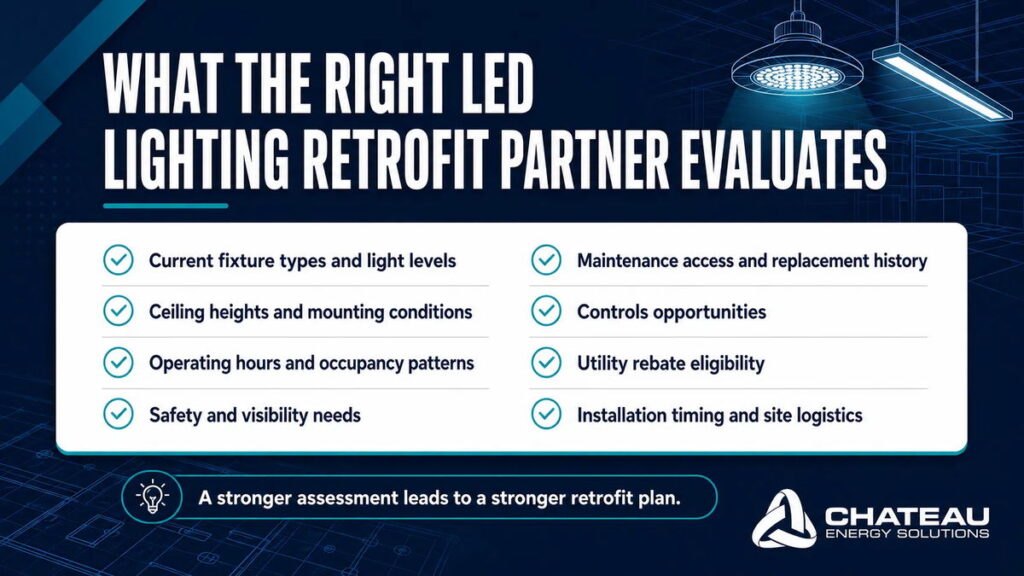
A comprehensive lighting audit should capture more than fixture counts. It should look at fixture types, mounting heights, operating hours, current light levels, controls, maintenance patterns, space use, exterior lighting needs, and any areas where visibility, comfort, safety, or consistency are concerns.
A good audit should do more than document existing conditions. It should explain what the upgrade means for the people involved in the decision. Facilities teams need a clear picture of the changes being proposed, operations leaders need to understand any impact on day-to-day activities, energy managers need realistic savings projections, and procurement teams need clear documentation that supports informed purchasing decisions.
If a vendor gives you a price before they understand your facility, that is a warning sign.
A lighting retrofit is only successful if the installed solution performs well in the actual space.
The right LED upgrade partner should evaluate the environment before recommending products. That includes temperature, dust, moisture, vibration, ceiling height, visual tasks, exterior conditions, safety needs, occupancy patterns, and maintenance access.
In industrial environments, lighting must support visibility and safe movement around equipment, inventory, and work areas. In healthcare, lighting must account for patient comfort, staff needs, infection control considerations, and 24/7 operations. In retail and distribution environments, lighting quality affects sales floors, back-of-house areas, storage, loading, movement, and consistency across multiple sites. In automotive dealerships and service environments, lighting needs to support both customer-facing spaces and task-heavy work areas.
The fixture is important, but the application is even more important.
A lower-cost fixture that is not right for the space can create glare, shadows, poor color quality, early failures, or inconsistent light levels. The better question is not “What is the cheapest fixture?” It is “What solution will perform well in this facility and hold up over time?”
This is where many lighting projects succeed or struggle.
A proposal may look good on paper, but the installation plan determines whether the project will go smoothly for the facility. Your LED lighting retrofit partner should be able to explain how the work will be scheduled, who will manage crews, how materials will be staged, how safety will be handled, how areas will be turned over, and how communication will work during the project.
For facilities that operate during installation, this is especially important. The partner should understand how to work around production shifts, patient care, customer areas, school schedules, loading times, parking lots, security requirements, and employee access.
In Chateau Energy’s LED upgrade at the Rehabilitation Hospital of Kingsport, implementation had to account for a 24/7 patient care environment, limited on-site storage, phased work areas, compliance requirements, and the need to avoid disruption. The project included more than 1,000 LED fixtures and was completed zone by zone with staged deliveries and careful coordination.
That is the level of planning facility teams should expect from a lighting upgrade provider.
Price matters. It always does. But an LED lighting upgrade or retrofit should be evaluated on total value, not just the lowest upfront number.
A good partner should provide a clear financial model that includes estimated energy savings, maintenance savings, available rebates or incentives, project cost, payback, and any financing options that may be useful. Financing or Energy as a Service may not be needed for every project, but it helps to have a partner who can provide those options when capital availability, approval timing, or portfolio scale make them worth considering.
This is especially important when facilities teams need to make the case to finance, operations, ownership, or procurement. A strong proposal should help answer the questions those groups will ask:
How much energy will this save?
How will it reduce maintenance burden?
What incentives are available?
What is the expected payback?
How will the project affect operations?
What happens if products fail?
Who handles warranties?
Chateau Energy’s lighting team includes rebate and warranty administration as part of its lighting upgrade work. That matters because rebates can improve the financial case, and warranty support can reduce the burden on internal teams after installation.
Utility rebates and incentives can make a meaningful difference in project economics, but they are not automatic. They often require the right product documentation, timing, application steps, utility coordination, and follow-through.
If a lighting retrofit vendor mentions rebates but expects your team to manage the process, ask more questions.
The right LED lighting upgrade partner should be able to identify available incentives, estimate their impact, prepare the required documentation, submit applications, and manage the process through completion. For larger portfolios, this becomes even more important because rebate programs can vary by utility territory and may change over time.
For Encompass Health, Chateau Energy administered utility rebates as part of a national LED lighting program, helping provide more than $510,000 in avoided capital costs across the program.
That is the kind of support that can help an internal project move from a “good idea” to an approved investment.
A polished proposal is helpful, but it does not tell you how a company will communicate once the work begins.
Find out how the provider communicates during the project and who will be responsible for day-to-day coordination. It is also worth discussing how they handle unexpected issues in the field, such as product delays, access restrictions, scheduling changes, or site conditions that differ from the original plan. Before moving forward, ask what the closeout process looks like and what documentation, records, or warranty information will be provided when the work is complete.
The answers should be specific.
Our Heatec case study highlights how effective communication and project coordination can contribute to a successful lighting upgrade. The facility needed a customized solution that fit both its lighting needs and financial requirements. Chateau Energy worked with plant personnel to determine an implementation schedule that allowed production to continue during installation.
That is what facility and operations teams should be looking for: a partner who can explain the plan, manage the details, and reduce surprises.

There are several warning signs that should make facility and operations leaders pause when looking for a LED lighting upgrade or retrofit partner.
Even if you are starting with one facility, it helps to choose a lighting retrofit provider who can think beyond a single project.
Many organizations begin with one location and then expand to additional facilities once the results are proven. That expansion is much easier when the partner understands documentation, product standards, rebate differences, site variation, and implementation across different building types.
Chateau Energy has supported multi-site lighting and energy efficiency programs across healthcare, retail, distribution, manufacturing, and education environments. In a large retail and distribution center program, for example, Chateau Energy improved energy efficiency across hundreds of locations. In healthcare, our work with Encompass Health has included more than 75 LED lighting projects to date.
A single-site project and a multi-site program require different levels of planning. The right partner should be able to support both.

Chateau Energy supports LED lighting upgrades and retrofits across commercial and industrial facilities nationwide. Our team brings lighting experts, engineers, project and construction managers, lighting equipment specialists, and rebate and warranty administrators into one coordinated process.
That structure is necessary because most lighting projects involve more than one decision.
There is the technical decision: what should be installed?
There is the operational decision: how should the project be completed without creating unnecessary disruption?
There is the financial decision: how do savings, rebates, payback, and financing options support approval?
There is the long-term decision: how will the facility maintain the new system after the work is complete?
Our role is to help clients move through those decisions with a process built around audits, customized lighting design, project management, installation, rebate support, warranty administration, and ongoing communication.
That experience shows across different environments. At Heatec, the project improved lighting quality and safety while reducing energy use and maintenance costs in a manufacturing plant. At Rehabilitation Hospital of Kingsport, the project supported patient comfort, staff visibility, and facility standards in a 24/7 healthcare setting. In a retail and distribution center program, Chateau Energy helped improve energy efficiency across hundreds of locations. For Hennessy Lexus of Gwinnett, the lighting design needed to save energy while also supporting how vehicles appeared in customer-facing and service areas.
The right lighting partner should make the project easier to approve, easier to execute, and easier to live with after the installation is complete.
An LED lighting retrofit can reduce energy use, lower maintenance demand, improve visibility, support safety, and make a facility feel better to work in. But those outcomes depend on the quality of the plan and the partner behind it.
When evaluating an LED lighting retrofit partner, look beyond the fixture schedule and the price. Look at how they audit, design, communicate, manage installation, handle rebates, support warranties, and protect your operations during the work.
A strong partner will help you understand what needs to happen, why it matters, what the project should cost, how the work will be completed, and what results you can expect.
That is how a lighting upgrade becomes more than a replacement project. It becomes a practical investment in the facility.
Chateau Energy helps commercial and industrial organizations evaluate, design, and implement LED lighting upgrades that reduce energy waste, improve lighting quality, and support operational goals.
If you are comparing LED lighting upgrade or retrofit vendors or evaluating whether your facility is ready for an upgrade, our team can help you understand the opportunity and build a practical path forward.
Learn more about Chateau Energy’s Lighting Upgrades & Retrofits
Look for a partner with experience in facilities like yours, a strong audit process, customized lighting design, clear financial modeling, installation management, rebate support, warranty administration, and strong communication from evaluation through closeout.
A vendor may focus mainly on selling fixtures or installation. A true LED lighting upgrade partner helps evaluate the facility, design the right solution, model savings, manage rebates, coordinate installation, support warranties, and reduce the workload on your internal team.
A lighting audit helps identify current fixture types, light levels, operating hours, maintenance concerns, space use, and installation needs. Without that information, product recommendations and savings estimates may be based on assumptions.
Not automatically. The lowest upfront price may not include the right products, controls, installation planning, rebate support, warranty administration, or closeout documentation. Evaluate total value, not just fixture cost.
In many facilities, yes, but it requires planning. A good lighting retrofit or upgrade provider should coordinate work around operating hours, production schedules, patient care, customer areas, site access, deliveries, and safety requirements.
Ideally, your LED upgrade partner should manage the rebate process. They should identify available incentives, prepare documentation, submit applications, and track the process so your team does not have to manage it separately.
In some cases, yes. Financing or Energy as a Service can help organizations move forward with lighting upgrades when capital budgets, approval timing, or portfolio scale make a traditional upfront purchase harder to approve.
Chateau Energy supports LED lighting upgrades and retrofits for commercial and industrial facilities nationwide, including manufacturing plants, warehouses, healthcare facilities, educational institutions, utility companies, retail spaces, dealerships, distribution centers, and other complex building environments.
Director of Business Development
Chateau Energy Solutions
Chris Byerly is Director of Business Development at Chateau Energy Solutions, where he helps clients develop and execute energy efficiency and EV charging infrastructure projects. With nearly 20 years of experience consulting, designing, and selling energy efficiency projects and programs, Chris has worked with customers across multiple industries throughout the U.S. His background includes deep knowledge of lighting, electrical infrastructure, sustainability-focused upgrades, and the manufacturer, distributor, and contractor relationships that help projects move forward. Outside of work, Chris spends his time playing or coaching rugby, a sport that has given him plenty of stories and a few bruises to go with them. Connect with Chris on LinkedIn.
Chateau Energy Solutions Making Energy an Asset®
Whether you need to fast-track power for a new facility, upgrade hundreds of sites, or electrify your fleet, Chateau Energy helps you reach your energy goals faster and smarter.